Reading depth
- Q1 — Seven industries: who is affectedThe cost passes through to consumers as higher service fees or slower infrastructure refresh.Jump to section
- Q2 — Can products be maintained without memorySince firms must keep producing, four patterns emerge: hikes, spec cuts, EOLs, and delays. DDR4 turning pricier than server DDR5 is a first in history.Jump to section
- Q3 — How large is the marketThe 2026 DRAM market is estimated around $128B, but estimates vary widely by firm. No single source is the answer; read it for direction.Jump to section
- Q4 — Why are the big-3 walking away from a goldmineThe big three walk away because the same wafer earns more. HBM needs 3x the wafer of DDR5, so the ramp directly compresses general-purpose supply.Jump to section
- Q5 — Who can offer alternativesOnly five candidate groups can fill the gap: CXMT, the Taiwan four, Jeju, and more, all with clear limits. Sanctions hold CXMT, small capacity holds Taiwan.Jump to section
- Q6 + Q7 — The two faces of the super-cycleThe supercycle has two faces. The industry enjoys a record golden age while consumers face regression in price hikes, option cuts, and missed launches.Jump to section
- Q8 — What to doThe real beneficiaries spread in layers beyond the trio to HBM equipment, materials, and gap-filling suppliers. A multi-layer approach beats trend trading.Jump to section
- Social implications of the super-cycleThis cycle adds a new dimension to the digital divide. Internet and phone gaps are largely solved, but memory hikes newly widen device and AI-access gaps.Jump to section
- Conclusion — eight answers + monitoring calendarThe AI memory supercycle is a golden age for industry and investors and a regression for consumers at once. Investors who grasp this use a multi-layer approach.Jump to section
Key Summary
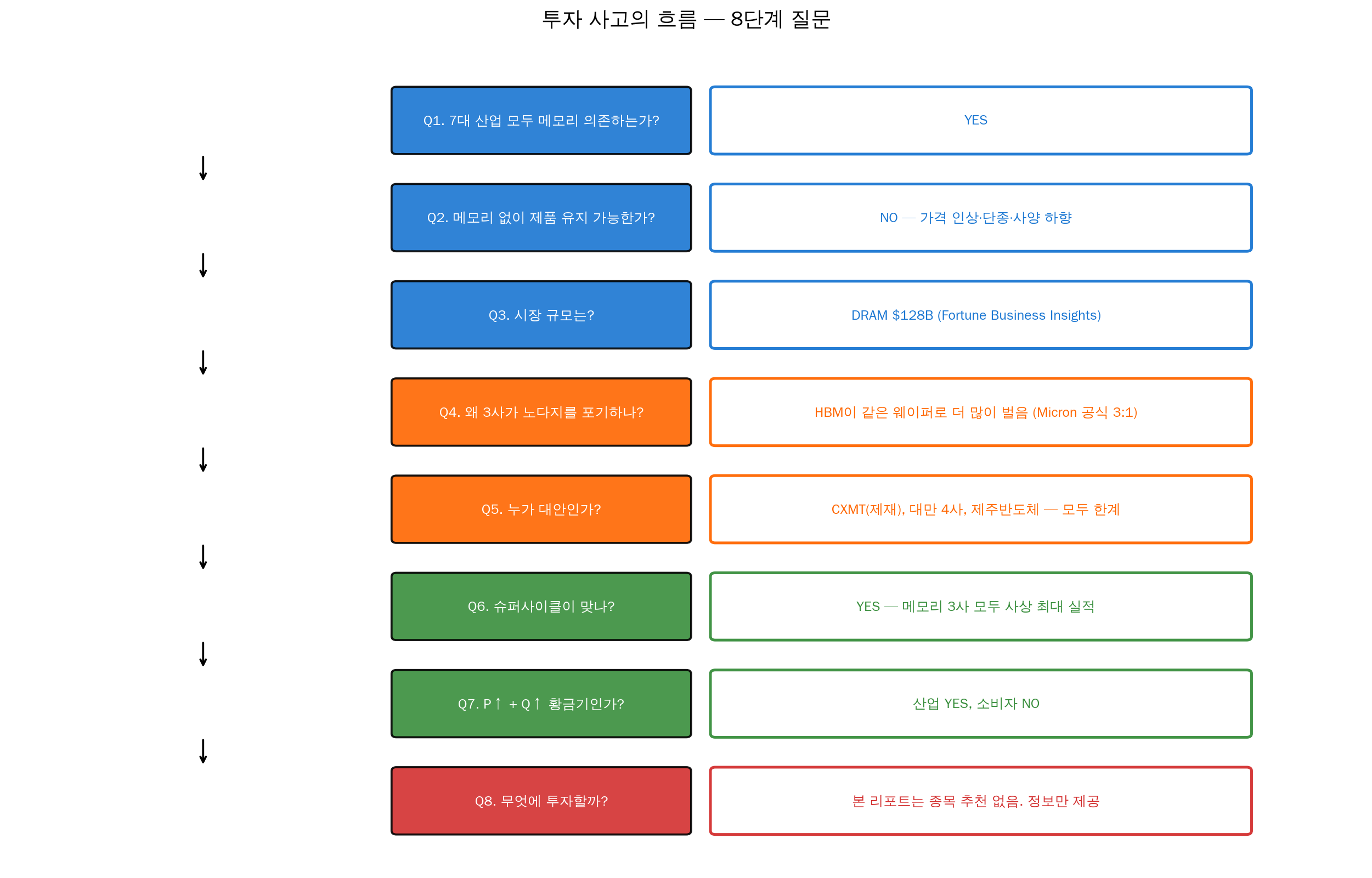
<Chart 1> Value-investing logic — the 8-step inquiry
The memory super-cycle is in motion, but the question who owns the golden age is the report's starting point. By company disclosure, the memory big-3 are at all-time peak earnings and AI infrastructure investment is exploding — an industry golden age. At the same time, by primary sources, Apple's Mac mini is up 33%, the Galaxy S26 is up $100, NVIDIA is skipping a new GPU launch for the first time in 30 years, and IDC forecasts a -11.3% PC contraction — an unambiguous consumer regression. The IDC analysis cited on the Wikipedia HBM page condenses it: "This is a zero-sum game: every wafer allocated to an HBM stack for an Nvidia GPU is a wafer denied to the LPDDR5X module of a mid-range smartphone."
This report doesn't claim "buy SK Hynix because of the memory shortage." It asks instead: why does this affect daily life, is it justified, and what happens after? Eight questions follow.
Q1. Do all seven major industries depend on memory? — Yes.
Q2. Can products be maintained without memory? — No.
Q3. How big is the market? — DRAM at roughly $128B per Fortune Business Insights.
Q4. Why are the big-3 walking away from a goldmine? — HBM consumes 3x the wafer space (Micron official).
Q5. Who can offer alternatives? — CXMT (sanctioned), Taiwan four, Jeju Semiconductor — all constrained.
Q6. Is this really a super-cycle? — Yes; record earnings on company disclosures.
Q7. Is it a P↑+Q↑ golden age? — Yes for industry; no for consumers.
Q8. What to invest in? — A multi-layered approach rather than just buying the memory big-3.
📌 Bottom line — The AI memory super-cycle is a two-faced phenomenon, with an industry golden age and consumer regression progressing simultaneously. Only investors who internalize that duality can practice value investing rather than trend chasing.