Microsoft — GPU Rental Rates Rebounded 40%, and the Market Started Rereading Cloud Capex
Fiscal 2026 fourth quarter delivered $90 billion of revenue, Azure up 43% in constant currency, and commercial remaining performance obligation of $678 billion. With one-year compute rental contracts up 40% from the trough and cheap 2024 to 2025 deals rolling off in sequence, the market has begun pricing the assumption that already-installed capacity turns into an asset whose unit price rises without incremental investment. In a quarter when Alphabet and Amazon both went free cash flow negative, this company alone held $19.6 billion positive
Microsoft beat across every line in fiscal 2026 fourth quarter with $90 billion of revenue and $4.74 adjusted earnings per share, and proved reacceleration with Azure up 43% in constant currency plus a 45% guide for the coming quarter. The more important shift sits on the price side. With one-year compute rental contracts up 40% from the trough and cheap deals rolling off in sequence, revenue per unit rises on already-installed capacity without incremental investment. Operating cash flow of $55.4 billion and free cash flow of $19.6 billion do not contradict that direction. The risk sits with accounting and counterparties rather than growth, and both are traceable through disclosure footnotes.
Reader's Brief — 30-second TL;DR
Advanced
Why Now
Fiscal 2026 fourth-quarter results on July 29, 2026. A stock that had answered five straight earnings beats with negative moves rose 15.5% on July 30 to close at $451.10. It is the first instance in 2026 of the market responding to hyperscaler capital spending with a positive sign. The next readings are whether Azure meets 45% in the October 29 first-quarter results, the lease commitment footnote in the same filing, and continuously the one-year contract price indices for H100 and H200.
Winners ?? Losers
The company occupies everything from layer one of the real economy, billing Copilot seats, through layer three infrastructure spending, and is a pure payer only against layer four memory. Some $25 billion, or 13% of capital spending, is component price rather than volume, and the other side of that ledger holds memory suppliers' profits. While compute rental rates rise, however, part of that burden shifts to the tenants beneath, meaning labs and enterprises. The pressure comes from the depreciation curve and a thinning free cash flow cushion. Asset-life assumptions and lease reclassification defer expense recognition, so this balance sheet is where impairment lands first if generational turnover accelerates. Watch in order: whether Azure meets 45%, total leases not yet commenced, the rental rate index, and the customer concentration footnote.
Watch For
Reading depth
Q4 FY26 — $90 Billion in Revenue and a 15.5% Single-Day Reversal
Microsoft reported fiscal 2026 fourth-quarter results on July 29, 2026. Revenue of $90.0 billion, income of $40.6 billion, GAAP earnings per share of $4.81 adjusted earnings per share of $4.74. Consensus stood at $4.29. Every line beat.
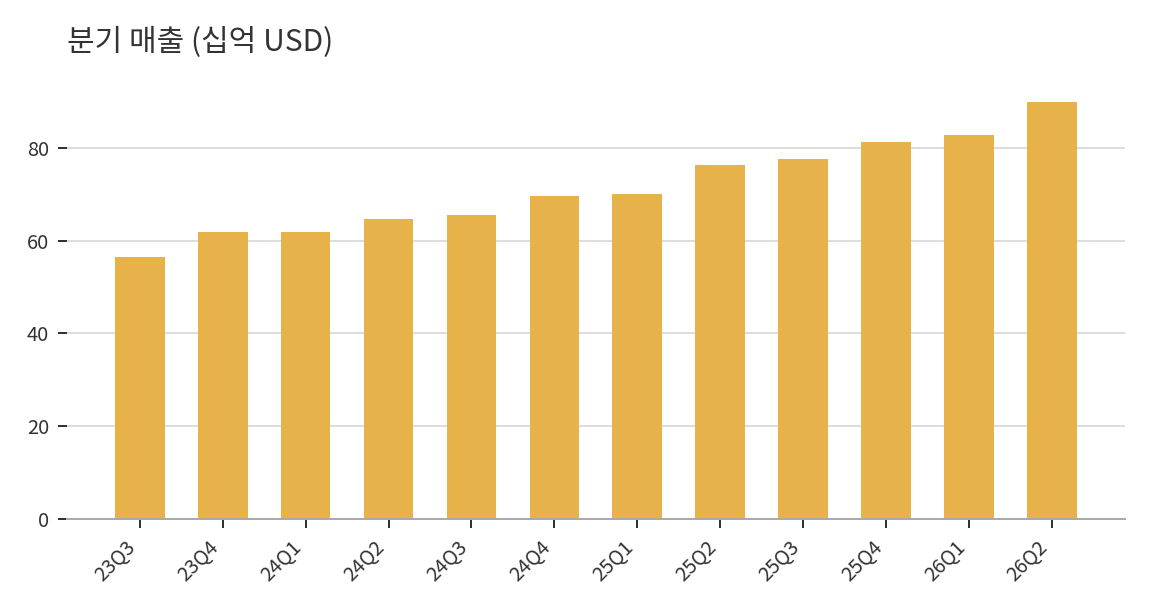
Revenue rose 18% year over year, and 17% in constant once exchange effects are stripped out. A $90 billion quarter is a first for the company. The last six quarters ran $70.1 billion, $76.4 billion, $77.7 billion, $81.3 billion, $82.9 billion and $90.0 billion.
Chart 1: Quarterly revenue, in billions of dollars
Chart 1: Quarterly revenue, in billions of dollars
For a company generating $330 billion a year, lifting the growth rate runs against the law of large numbers. Full-year fiscal 2026 revenue was $331.8 billion, up 18%, and operating income was $155.2 billion, up 21%. Profit growth outpaced revenue growth.
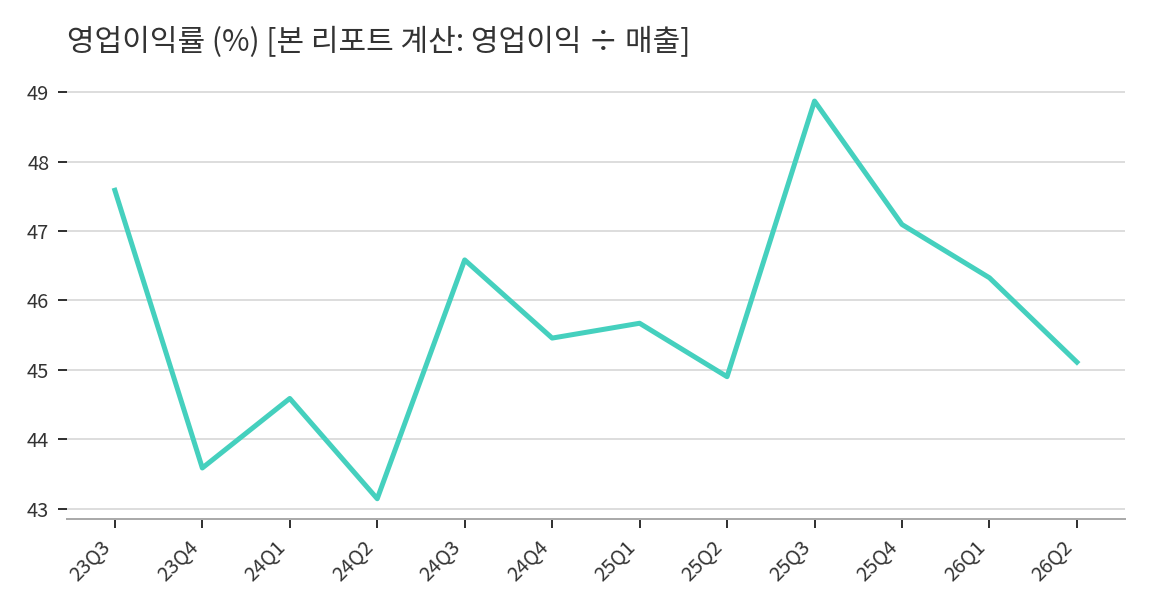
The operating margin was 45.1%. It held near 45% even as quarterly capital expenditure doubled from $17.1 billion to $35.8 billion. A margin that holds while depreciation charges surge means the software and cloud mix is absorbing the burden.
Chart 2: Quarterly operating margin, percent of revenue
Chart 2: Quarterly operating margin, percent of revenue
By segment, the source of growth narrows to one place. Intelligent Cloud is the engine, with Productivity and Business Processes behind it on M365 commercial contracts and Copilot seat expansion. Only More Personal Computing fell, down 4.4%, and the cause was not weak demand but higher PC prices driven by surging memory costs. The final section takes that up separately.
One item should be netted out when judging the quality of the quarter. The company disclosed that discrete items contributed $0.27 per share relative to its April guidance. The purely operational surprise is that much smaller than the headline.
A Sign That Flipped After Five Quarters
Going into the print, the stock sat near its low. The trailing one-year return was negative 22.6%, and despite five consecutive earnings beats the average reaction was negative. The prior quarter fell 3.9% after reporting; the one before that fell 10.0%. The market had been reading good results as a capital spending invoice.
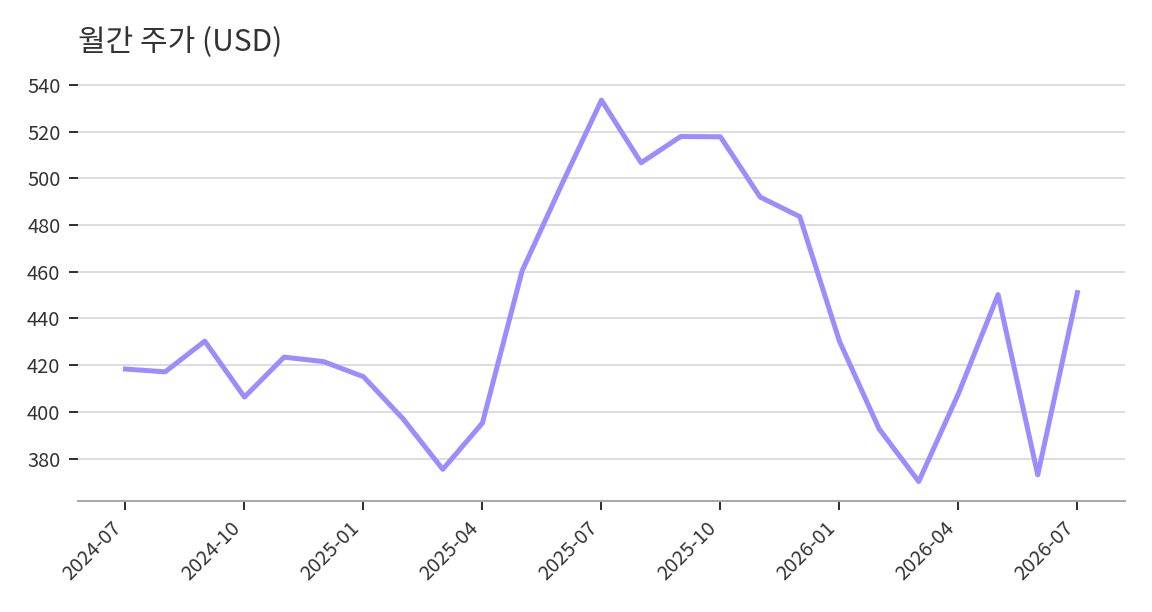
After the close on July 29 the stock rose more than 8% in extended trading, then gained 15.5% in the following regular session to close at $451.10. On a monthly basis that is $373.02 in June to $451.10 in July, up 20.9%. A move of that size is rare in a company this large.
Chart 3: Monthly closing price over the past twelve months, in dollars, from $373.02 in June 2026 to $451.10 in July
Chart 3: Monthly closing price over the past twelve months, in dollars, from $373.02 in June 2026 to $451.10 in July
Explaining that sign change by reacceleration alone gets you halfway. In the same week Alphabet and Amazon both raised capital spending guidance in substance, and Alphabet posted its first negative quarterly free flow on record. Only this stock rose 15.5%. What the market read was not the size of the spending but the speed at which it is recovered.
This quarter the market began reading capital expenditure not as a cost but as the prepurchase of an asset with pricing power.
Full access requires a free account
Sign in with Google to unlock the full body of every free report instantly.
This site runs on ads — the tier system rewards community contributions.
Comments
This report is provided for informational purposes only and does not constitute a recommendation to buy or sell any financial instrument. Investment decisions should be made based on your own judgment and responsibility. The analysis and opinions contained herein are based on information available at the time of writing and are subject to change.